Traditional Chinese Medicine
 |
Chinese
Medicine is holistic and has long history
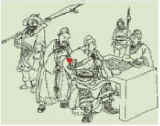
By the 3rd century, TCM Practitioner performed surgery and use acupuncture
to reduce pains during surgery operation |
For over 4000 years, the
Chinese have been using Traditional Chinese Medicine as a safe and
effective mean to holistic health and well being. Rather than perceiving
the human body as a simple assemblage of various organ systems, Chinese
medicine regards the human body as a non-decomposable unit. Within
the unit there are many pairs of balanced forces, general known as
the YIN and the YANG, that determine our state of health.
When the YIN and the YANG are in balance, we feel healthy
and energetic. However, when there is an imbalance between them, we
feel ill.
Traditional Chinese Medicine is an ancient
method of health care that combines the use of the following:
1. Chinese Herbal Medicine
2. Acupuncture (includes moxibustion and suction cupping)
3. Tui Na (Chinese Massage, Acupressure)
4. Food Therapy
5. Chinese therapeutic exercises (TaiChi and QiGong)
1. Chinese Herbal Medicine
 |
Chinese
herbal medicine is the major component in the system of Traditional
Chinese Medicine
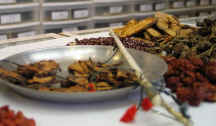
As early as 3000BCE, the Chinese Pharmacopoeia began to be documented
and continued to expand until over 3500 herbs were researched
and recorded |
Chinese herbal medicine is the major component in the system of
Traditional Chinese Medicine. Herbal medicine consist of a huge
collection of plants and other materials such as insects or minerals
that have different effects on our body. When knowledgeably used,
herbal medicine can have dramatic healing effects. The practice
of Chinese herbal medicine is an art, for the combination of herbs
into just the right formula takes a significant amount of skill
and knowledge. A formula may contain up to 10-15 herbs. Each formula
consists of a chief herb, a few herbs to assist, and a courier herb
to take the medicine to the site of the "lesion". Each
herb in the formula has a different role, working synergistically
with the others to bring about the therapeutic effect.
Chinese herbal medicine is traditionally used for internal organ
imbalances. It is often used as a complement to acupuncture, and
the two are often used in the same treatment. Each system affects
Qi of the body in specific ways. In many instances, herbal remedies
are used to supplement the body's Qi, and acupuncture is used to
manipulate Qi, focusing it where it is needed.
The conventional method for applying herbal therapy is by decoction
- a strong "tea" made by simmering raw herbs in water.
Traditionally, a specially glazed clay teapot is used to make the
tea. Since the decoction method is time consuming, and the taste
of the decoction is unpalatable to many, two alternative methods
were developed - pulverized herbs in capsules, and concentrated
Chinese herbal granules.
Concentrated Chinese herbal granules is a representation of a new
generation of Chinese herbal products, and it offers a safe and
convenient means of using herbs. They are extracts of herbs and
carry the same potency.
Please click the section on the top of the page to learn more about
herbal medicine.
2. Acupuncture
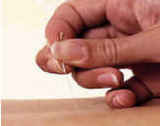 |
Treatments are relaxing,
enjoyable and virtually painless
Acupuncture and Acupressure are another forms of Chinese Medicine
therapies applied to improve the flow or quality of the life
force, and to re-balance body energies.
|
Acupuncture, with its accompanying techniques of moxibustion and
suction cupping, is the most popular therapy of TCM. Acupuncture
is used primarily for patients who experiences pain and feels out
of balance. It is very effective for many types of illness. The
World Health Organization (WHO) recognizes the ability of acupuncture
and Oriental medicine to treat over 43 commonly encountered clinical
disorders. Acupuncture is particularly helpful for disabled patients
after a stoke. It is also used as a preventative measure because
it strengthens the body's immune system. During an acupuncture treatment
session, fine stainless steel needles are inserted into the skin
at very specific points. The acupuncture needles are sterile and
they are disposed after each treatment.
Please click the section on the top of the page to learn more about
acupuncture.
3. Tui Na (Chinese Massage,
Acupressure)
Tui Na (Also known as Chinese massage or acupressure) is a form
of Asian bodywork that uses touch to balance the body's energy.
It most closely resembles the conventional Western massage. Many
of the techniques are similar - gliding (known as effleurage or
Tui), kneading (petrissage or Nie), percussion (tapotement or Da),
friction, pulling, rotation, rocking, vibration, and shaking. Tui
Na offers all of the benefits of traditional Western massage, plus
the ability to address and mitigate specific health concerns.
Despite the similarities, the intent of Tui Na is more specific
and therapeutic than the simple relaxation of a Western massage.
One of Tui Na's advantages over simple massage is its ability to
focus on specific problems, especially in the treatment of chronic
pain associated with the muscles, joints, and skeletal system. It
is especially effective for the relief of joint pain (such as arthritis),
sciatica, muscle spasms, and pain in the back, neck, and shoulders.
It also aids in the treatment of chronic conditions such as insomnia,
constipation, headaches (including migraines), and tension associated
with stress.
Tui Na does not simply work on the muscles, bones, and joints.
It works with the energy of the body at a deeper level. As the practitioner
senses the client's body with her hands, she is able to assess the
distribution of energy and affect its flow.
A typical Tui Na session uses various strokes along energy channels,
as well as gentle shaking, stretching, and joint movements. This
stimulates and releases the flow of energy, which helps balance
your physical and emotional state.
Tui Na uses rhythmic compression along energy channels of the body,
as well as a variety of techniques that manipulate and lubricate
the joints. Tui Na directly affects the flow of energy by holding
and pressing the body at acupressure points.
4. Food Therapy
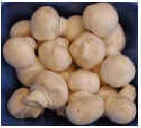 |
Chinese dietary supervision
is a sophisticated system that evaluates food according to its
properties and therapeutic value.
Whole-grain products, beans, fresh vegetables, and mushrooms
are frequently recommended
|
In Traditional Chinese Medicine,
herbs and food go hand in hand in influencing the body's energy
fields. It follows that a patient's diet must align with medications
taken for benefits to be apparent. Chinese dietary supervision is
a sophisticated system that evaluates food according to its properties
and therapeutic value. Whole-grain products, beans, fresh vegetables,
and mushrooms are frequently recommended. TCM practitioners, on
the other hand, advise patients to avoid raw food, because it is
too "cold"; white sugar, because it is too rich and would
over-stimulate the pancreas and liver; strong spices, for they disperse
energy to the surface of the body. Patients are also advised to
avoid coffee, because it overtaxes the adrenals; cold dairy products,
because they are too congesting; and shellfish and citrus, because
they are too "cold" and "moist".
Please click the section on the top the page to learn more about
food therapy.
5. Chinese therapeutic exercises
 |
Through intensive practice
of chi-gong, an entire set of beneficial psychological and spiritual
conditions emerges. In promoting emotional well-being, chi-gong
exercises help build confidence among patients in their battle
against diseases.
|
Another component of Traditional Chinese Medicine used in the treatment
of diseases, especially cancer, is Chinese therapeutic exercise.
It comes in two forms: tai-chi and chi-gong. The purpose of both
exercises is to enable a person to regulate and direct the flow
of qi within his or her own body. A student in exercise training
is taught to focus his or her qi in a place two inches below the
navel, called the "dan tian", or vital center. From this
center, the qi is said to emanate to distant regions of the body.
Upon practice, students can sense the presence of qi at the vital
center in the form of localized warmth and can then direct the life
energy to specific parts of the body. In many cases, the practitioners
prescribe exercises that specifically address the patients' illnesses.
The perspective of TCM on tai-chi and chi-gong differs from that
of Western medicine. Chinese medicine believes these exercises energize
the body's vital forces, balances yin and yang, strengthens blood
circulation, and improves the patient's emotional and mental states.
Western medicine believes that the exercises, like yoga, increase
the absorption and utilization of oxygen.
Through intensive practice of chi-gong, an entire set of beneficial
psychological and spiritual state emerges. In promoting emotional
well-being, chi-gong exercises help build confidence among patients
in their battle against cancer. Many cancer patients, who have been
practicing chi-gong and tai-chi, reflected that a positive attitude
plays an important role in curing the disease.
Please click the section on the top the page to learn more about
therapeutic exercises.
At Sanjiu, we pride ourselves in our strong
commitment to showcasing the best of modernized Traditional Chinese
Medicine in the prevention and treatment of illnesses,
and improving the health conditions of our clients. By staying at
the forefront of modern Chinese Medicine clinical practices and
maintaining high ethical and professional standards, our highly
qualified and experienced physicians will provide our clients with
quality, safe, and effective services. Please explore our site to
learn more about Chinese Medicine and the 999 Sanjiu Chinese Medicine
clinics.Please feel free to contact one of our medical centers for
more information.
Our Practitioners
Our Chinese Medicine Practitioners at Sanjiu are all world-class with
exceptionally experienced and qualified in their areas of practice:
- All of them were graduated from famous and recognized Medical
Universities studying Chinese Medicine and acupuncture.
- They holds Bachelor, master degree and doctorate degrees. Some
of them are professors in famous universities. They were trained
in both Chinese Medicine and Western Medicine and are competent
both forms of practices.
- They have at least 10 years clinical experience. Most of them
have more than 20 years of experiences.
- They are all registered as Practitioners of Chinese Medicine and
acupuncture in Ontario, Canada.
Other than our full-time practitioners, we regularly invite famous
Chinese Medicine Practitioners, scholars and professors from China to
conduct training and meeting with our practitioners.
The following is the introduction of our
Chinese Medicine practitioners:
|
|
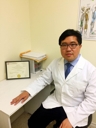
Zhaohui (Stanley) Liang
Registered Traditional Chinese Medicine Practitioner in Ontario,
Canada
Registered Acupuncturist in Ontario, Canada
Ph.D. in Medical Sciences in Acupuncture, Moxibustion &
Massage from Guangzhou University of Chinese Medicine
.Zhaohui Liang is a Registered TCM Practitioner (R. TCMP)
and / Registered Acupuncturist (R. Ac) in Ontario, and is
a Registered Deputy Chief TCM Doctor in China. He is a member
of China Association of Acupuncture and Moxibustion (CAAM),
former Deputy General Secretary of the Abdominal Acupuncture
Committee of CAAM. He has practiced TCM and acupuncture since
he graduated from Guangzhou University of Chinese Medicine
in 2003 for 12 years. He worked as an acupuncture specialist
in the Acupuncture Department of Guangdong Provincial Hospital
of TCM from 2003 to 2014. He received his Ph.D. in Medical
Sciences from Guangzhou University of Chinese Medicine in
2013. Until now, he has published more than ten research paper
in world renowned peer-review medical journals, and he is
a Guest Editor and Reviewer of many international medical
journals.
Zhaohui Liang speaks fluent English, Cantonese, and Mandarin.
He is nice and easy to communicate.
Consultation Time:
Monday, Tuesday, Thursday and Saturday (10am-6pm)
|
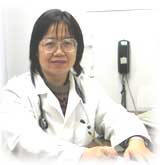 |
Zhong Bei, R.TCMP & R.AC
Registered Practitioner and Acupuncturist
Master degree of Medicine, Beijing Medical University
Focus in Acupuncture , Acupressure & Herbal Medicine
Master degree of Medicine, Beijing Medical University, China
National University. She has more than 20 years of clinical
experience in acupuncture, herbal medicine, Chinese TuiNa
(Chinese therapeutic massage). She was the Associate Professor
in Traditional Chinese Medicine Researching Institute and
the Associate professor in Beijing Construction Hospital.
She was awarded "Beijing City's Model for Diligent Worker
(2000), Golden medal of China Institute of Chinese Medicine
(1995), Reward of Beijing City's Excellent Clinician, (1989)
She received many research awards providing funds to Traditional
Chinese Medicine research.
|
|
|
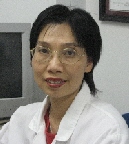 |
Wang Sui Bin R.TCMP & R.AC
Registered Practitioner and Acupuncturist
Bachelor degree of Medicine, Guangzhou Medical College,
China
She is experienced in Gynecology, Pediatrics and treatment
of skin diseases. She also focus in Acupuncture and Acupressure
She is experienced for her practice in prevention of diseases
and recovery of good health after serious diseases, recovery
from surgery and other treatments. Wang obtained her Bachelor
Degree of Medicine in Guangzhou University of Chinese Medicine.
She was a licensed Practitioner in China, member of the Chinese
Medicine and Acupuncture Association of Canada, fellowship
of the Medical Science Institute of China Medicine. She has
more than 20 years of clinical experience in herbal medicine
and acupuncture. Excellent experience in woman and children's
diseases, skin diseases, cancer, diabetes, hepatitis, gallstone,
hematuria. Her experience in women's diseases include the
treatment of such as dysmenorrhoea and abnormal menstruation.
|
|
|
Our Goal
Our goal is to provide patients with appropriate, professional,
safe, effective and affordable Traditional Chinese Medicine services
and treatments. The Clinic showcases modernized Traditional Chinese
Medicine at its best, and will use Sanjiu's medical products for
maximum efficacy and safety.
About CLINIC 39
CLINIC 39 Acupuncture and Herbs is the best
,high performance, and safe clinic in modern Chinese Medicine and
acupuncture in North America. We team up with famous Pharmaceutical
Companies and Medical Universities in China to deliver the best
Chinese Medicine, acupuncture, and other forms of treatment to Canadians.
The locations of our Chinese Medicine
and Acupuncture Centers
We have patients coming from coast-to-coast
of Canada. In order to serve our patients better, we are expanding
our clinics to cities outside Toronto. At the moment we have three
centers, one in North York, one in Kitchener and the third one is
in Mississauga
North York Medicine
and Acupuncture Center/clinic
Our North York Medical Center is the first clinic of its
kind in North America. It provides a modern, comfortable and spacious
environment for patients, featuring the space of more than 7,000
square feet with accommodations for 4-5 Chinese Medicine Practitioners
and acupuncturists. The center also features a training facility,
and regularly organizes heath related classes and seminars for patients
and the general public. Examples of those classes include fundamentals
of Chinese Medicine, acupuncture, Qi Gong, Tai Chi, and other exercises.
Kitchener
Chinese Medicine and Acupuncture Center/clinic
The center is located at the back of Grand River Hospital of Kitchener
at Park Street. The clinic is small in comparison with the headquarters
but compact and modern. The Practitioner in charge is Wang. She
is focus in acupuncture and have unique experiences in pain management,
depression and stoke. She is fluent in English.
Mississauga
Chinese Medicine and Acupuncture Center/clinic
The center is located at the center of Peel region providing easy
access from the Cities of Mississauga, Brampton, Oakville and Etobicoke.
It provides a complete solution in modern Chinese medicine, including
acupuncture, moxibustion, herbal medicine, nutrition/food therapy,
acupressure, and cupping.
The center also carries Chinese health products such as teas, patent
medicines, Ginsang and many other health-care products
Our Services :
Our special programs
Cancer Support and Treatment
Program
Cancer Survivor Preventive
Maintenance Program
Weight Management
Program
Health care Insurance Program
Clinic Hours:
Monday to Saturday
9:30 a.m. - 6:30 p.m.
Sunday close
Holidays closed
(Because of COVID-19 precaution, we are only open on Saturday.
For other times, please call 416-497-6339 for appointment. Thank
you.)
|